
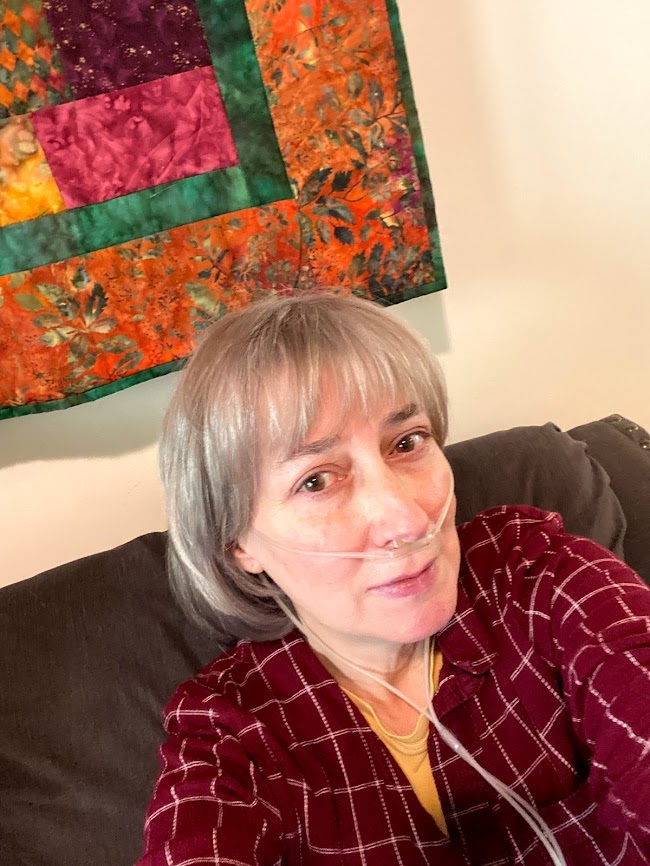
This is the story of how I came to wear a cannula. Not the sexiest of stories, but it’s what I’ve got.
I have never been what you would call a strong athlete, but something was clearly wrong in the fall of 2019. Frustrated at my slow pace walking up the hills around our house, I joined a gym. And thought, dang, why do they make the Level 1 setting so hard on these bikes? And why do I get out of breath after just a couple of minutes on the elliptical? But I plugged away and got a little better with time.
Then I discovered they were mislabeling trails in the guidebooks too. “You call this an easy trail?” I fumed to my husband and son, who in fact hiked it easily. In my defense, it was far from a flat trail and in places, not a trail at all, but a wet stream bed.
Then there was the cross-country ski. My husband and son found the difficult trails challenging in an invigorating way. They literally brought me to tears. I developed a screaming headache as I panted uphill. I slid backward. Finally, I took off my skis and climbed up slowly in my boots.
The next day, I had pneumonia. And I never really got better. It was harder than ever to walk up the hills in my neighborhood.
Lung x-rays led to CT scans, a pulmonary function test, an unhelpful prescription for an inhaler, a PET scan, a bronchoscopy. Then finally, a stay in the hospital, more tests, and in September 2020, a diagnosis—pulmonary hypertension.
Pulmonary hypertension is a rare disease that many pulmonologists don’t even know how to treat. It’s high pressure in the blood vessels that move blood between the heart and the lungs. My regular blood pressure—which measures the pressure in the system that moves blood around the body—has always been fine, and in fact, a bit low.
There are five types of pulmonary hypertension—and several different causes. My type, World Health Organization Group 1 is pulmonary arterial hypertension (PAH). My disease is idiopathic, meaning they don’t know what caused it.
My understanding of PAH is that the blood vessels of my lungs have for some reason begun changing shape and narrowing, making it harder and harder for the heart to push blood through. So patients like me develop right-side heart failure. This is because your heart, as one doctor described it, is doing the equivalent of running a marathon 24 hours a day for days on end.
At this point, I am on four oral medications for this disease, plus oxygen. My pressures are still elevated, but my heart looks much more normal, my doctor says.
The meds have seriously nasty side effects–nausea, headaches, constant congestion, diarrhea, flushing. My face is bright red most of the time. Thankfully, the internet makes is easy now to find a community for just about everything, so I have been able to find other people going through this who can say “yes, that side effect is normal and here’s what helps sucks,” and “this is the most comfortable cannula I’ve found.”
It’s been two years since I started to realize something was wrong and a year and a half since my diagnosis was confirmed. I’ve been wanting to blog but have been consumed with just getting through the day. I’m finally coming up for air, so to speak, and carving out my little corner of the internet.
 Cathy Brown, Freelance Journalist